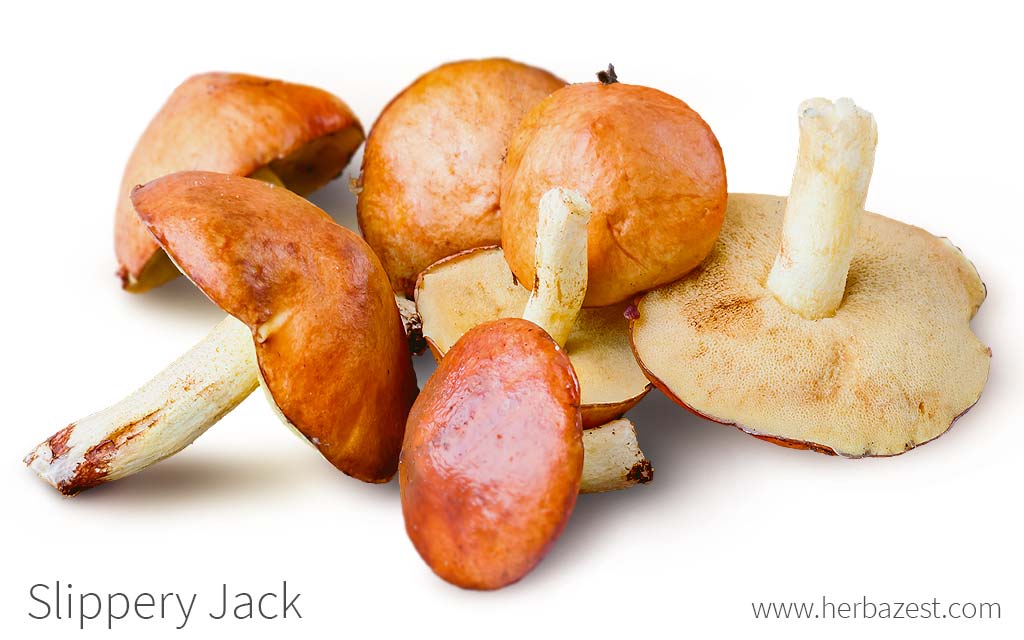
Slippery jack, also known as sticky bun mushroom or kallampa, is a forest mushroom that grows worldwide in symbiosis with pine trees. Its benefits have been recognized for centuries, and it has long been used in folk medicine to help address a variety of health issues, from headaches to gastrointestinal problems.
Slippery Jack Medicinal Properties
Health Benefits of Slippery Jack
Slippery jack's medicinal properties have been utilized for centuries in folk medicine, particularly for managing pain and inflammation associated with various conditions. Based on traditional uses and supported by early scientific research, its main benefits include:
Treating gastrointestinal problems. Thanks to its anticholinesterase properties, slippery jack may help relieve stomach aches and intestinal discomfort.
Relieving headaches. Its influence on neuromuscular function has led to traditional use for headache relief.
Additionally, slippery jack has shown potential for:
Improving brain function. Recent studies suggest slippery jack may have potential in alleviating symptoms of depression, Alzheimer's disease, and dementia.
How It Works
Suillin, a natural compound commonly found in slippery jack mushrooms, belongs to the prenylphenol family, which is known for a wide range of biological activities including antioxidant and antimicrobial effects.
In an in vitro study, suillin demonstrated the ability to inhibit acetylcholinesterase (AChE), the enzyme that breaks down acetylcholine, a key neurotransmitter involved in learning, memory, and attention.1 By slowing this enzyme's activity, suillin from slippery jacks showed potential relevance for cognitive support and may help explain why slippery jack has long been valued in Andean traditional practices for easing discomfort and promoting clarity.
Side Effects & Cautions
Slippery jack is mostly safe in culinary amounts. However, the slime coating on its cap may cause indigestion, gastrointestinal discomfort, or allergic reactions in some individuals. These effects can often be avoided by removing the mushroom's cap skin and tube layer, washing it thoroughly, and cooking it well.

Slippery Jack Nutrition
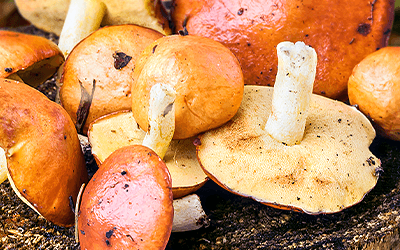
Slippery jack, or kallampa, is among the most commonly consumed mushrooms, not only for its medicinal value, but also for its content of B vitamins, minerals (mainly iron and zinc) and protein. Compared to other mushrooms, it provides more vitamin E and a fair amount of fiber. However, precise nutritional value can vary based on origin, and reliable data remains limited.
How to Consume Slippery Jack
Natural Forms
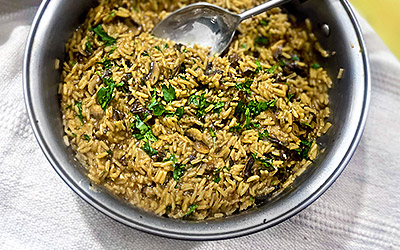
Cooked. This type of mushroom needs to be consumed cooked, after peeling the slimy cap layer. Slippery jack mushrooms can be sautéed and used to prepare broths, sauces, and more.
Dried. Dried slippery jack mushrooms need to be rehydrated in warm water for 30 minutes before using them in culinary ways.
Powder. Often combined with other mushrooms, slippery jack powder adds a mild umami and honey-like flavor to dishes.
Marinated. Like other fungi, slippery jack mushrooms can be preserved and used in recipes after draining.

Growing
As other mycorrhizal fungi, Slippery jack establishes a mutualistic relationship with trees, especially pines (genus Pinus), and thrives in temperate regions, forming an underground network of fungal threads, or mycelium, which ensures its survival for many years. It produces fruit bodies (mushrooms) season after season, typically from summer to autumn, under favorable conditions. Slippery jack is also cultivated commercially in pine plantations and is known for tolerating poor soils with low pH.
Additional Information
Biology
Slippery jack (Suillus luteus), also called sticky bun mushroom or kallampa, forms a symbiotic relationship with pine trees. Like other edible mushrooms, it has a fruiting body with a slimy, brown to orange-brown cap and pale-yellow pores underneath. These pores don't change color when bruised. Its light-yellow stem is up to 4 inches (10 cm) tall and about 1.18 inches (3 cm) in diameter, with a distinctive ring that covers the pores in early stages. The greasy texture of the cap skin and tubes is typically removed before cooking. Slippery jacks contribute to forest ecosystems by participating in nutrient cycling and supporting tree communication through mycorrhizal networks, commonly known as mycelium.
Classification
Slippery jack (Suillus luteus) belongs to the Boletaceae or Boletales family, which includes over 35 genera and about 787 species, many of which are edible and ecologically valuable.
Species
The Suillus genus encompasses over 70 mushroom species distributed across the native ranges of their host plants, from the Andes to boreal forests. Of these, 26 are edible. The most widely known are Suillus luteus and Suillus granulatus. Suillus grevillea and Suillus luteus are also noted for traditional medicinal uses.
Historical Information
Suillus luteus is native to Eurasia and was introduced to the Americas roughly 130-150 years ago. It has been traditionally collected and consumed by indigenous peoples throughout North, Central, and South America for both culinary and medicinal purposes.
Economic Data
While the slippery jack mushroom (Suillus luteus) holds significant economic value, commercial data is scarce. It grows across Eurasia and has spread to North and South America, South Africa, and Oceania. In South America, it is mostly as kallampa (or callampa) and harvested in pine plantations across Argentina, Chile, Ecuador, and Peru.
Other Uses
Forestry. Due to its unique symbiotic relationship with pine trees, slippery jack may contribute to forest restoration efforts.
Sources
- Ankara University, Discovering the Potential Mechanisms of Medicinal Mushrooms Antidepressant Activity: A Review, 2023
- Antioxidants (Basel), Discovering the Potential Mechanisms of Medicinal Mushrooms Antidepressant Activity: A Review, 2023
- BCM Plant Biology, Beneficial mutualistic fungus Suillus luteus provided excellent buffering insurance in Scots pine defense responses under pathogen challenge at transcriptome level, 2025
- Boletín de la Sociedad Micológica de Madrid, Etnomicología del género Suillus, una visión global, 2012
- Ciencia e Investigación Agraria, Effect of the geographical origin, culture media, and pH on the growth dynamic of the edible ectomycohrrizal mushroom Suillus luteus, 2012
- Encyclopedia of Mycology, Boletales, Volume 1, pp 329-360, 2021
- Food Chemistry, Mercury content and bio-concentration potential of Slippery Jack, Suillus luteus, mushroom, 2011
- Food Science and Technology International, Antioxidant capacity and mineral contents of edible wild Australian mushrooms, 2012
- Frontiers in Cellular and Infection Microbiology, Virome analysis of an ectomycorrhizal fungus Suillus luteus revealing potential evolutionary implications, 2023
- International Journal of Medicinal Mushrooms, Chemical Constituents from Mushroom Suillus luteus (Agaricomycetes) and Their Bioactivities, 2022
- LWT - Food Science and Technology, Vitamins, phenolics and antioxidant activity of culinary prepared Suillus luteus (L.) Roussel mushroom, 2014
- Michigan State University, Suillus luteus, 2018
- Mycologia, Understanding introduction history: Genetic structure and diversity of the edible ectomycorrhizal fungus, Suillus luteus, in Patagonia (Argentina), 2020
- Pharmacognosy Magazine, Optimization Extraction Process of Polysaccharides from Suillus granulatus and Their Antioxidant and Immunological Activities In vitro, 2016
Footnotes
- PLoS One. (2022). Suillin: A mixed-type acetylcholinesterase inhibitor from Suillus luteus which is used by Saraguros indigenous, southern Ecuador. Retrieved February 5, 2025, from: https://pmc.ncbi.nlm.nih.gov/articles/PMC9109927/