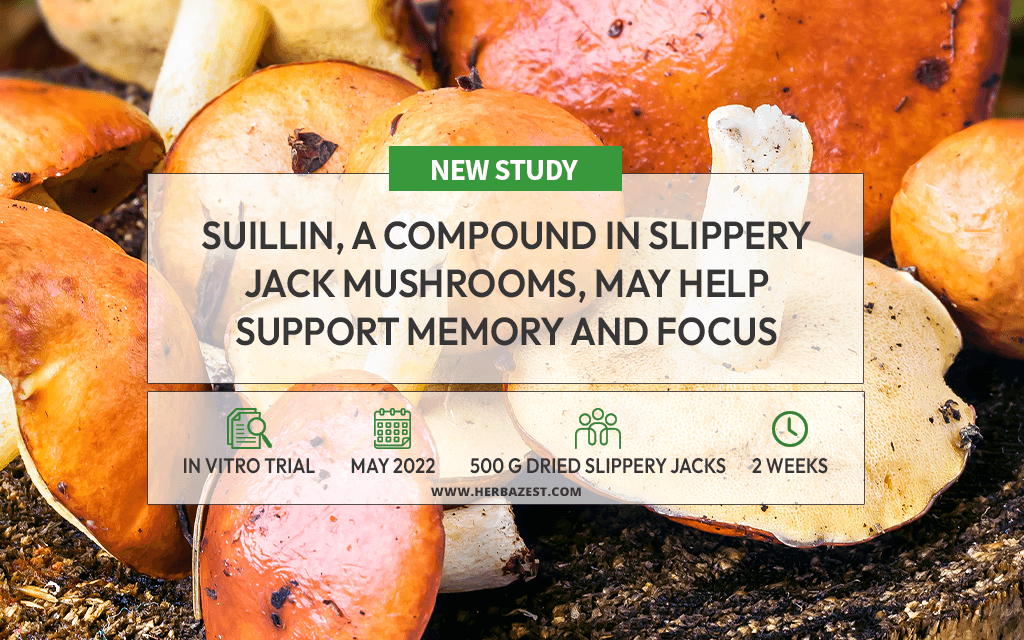
The Suillus luteus mushroom, known as slippery jack and “callampa” in parts of South America, has been traditionally used as both food and a remedy for headaches and digestive discomfort. Recent studies have begun to uncover the biochemical potential behind this edible fungus, long appreciated in Andean communities. Researchers from the Technical University of Loja set out to determine the key compounds in slippery jack and their effects on enzymes linked to memory and cognitive function.
The Study
The team collected about 500 grams of slippery jack mushrooms in the Loja province of southern Ecuador and prepared ethanol and ethyl acetate extracts. From these, they isolated several known fungal compounds (linoleic acid, ergosterol, and ergosterol peroxide), along with suillin, a compound common in mushrooms of the Suillus genus.
To explore whether these compounds affect brain-related enzymes, the extracts and isolated suillin were tested for their ability to inhibit acetylcholinesterase (AChE), an enzyme that breaks down acetylcholine, a neurotransmitter involved in memory, learning, and focus.
The Results
Both mushroom extracts showed moderate enzyme inhibition, while suillin demonstrated a stronger, measurable effect. Researchers observed that suillin can interact with the enzyme in more than one way, reducing its activity even in the presence of acetylcholine. Although not as potent as pharmaceutical drugs, suillin's activity places it among the few naturally occurring compounds in edible fungi with measurable AChE-inhibiting properties.
What Does this Mean?
These findings represent the first scientific evidence of enzyme-inhibiting activity in slippery jack mushrooms, providing a biochemical foundation for their traditional use as a natural remedy. The discovery of suillin's effect on acetylcholinesterase adds to growing evidence that everyday foods can influence brain chemistry in meaningful ways.
While more research is needed, identifying a bioactive compound with cognitive relevance in a widely consumed edible mushroom broadens the understanding of how diet can support brain health over time. Similar enzyme-modulating effects have been found in plants like sage and lemon balm, both known for supporting memory and concentration.1,2
Sources
- PLOS ONE, Suillin: A mixed-type acetylcholinesterase inhibitor from Suillus luteus which is used by Saraguros indigenous, southern Ecuador, 2022
Footnotes:
- Neuropsychopharmacology. (2006). Effects of cholinesterase inhibiting sage (Salvia officinalis) on mood, anxiety and performance on a psychological stressor battery. Retrieved November 19, 2025, from https://pubmed.ncbi.nlm.nih.gov/16205785/
- Evidence-Based Complementary and Alternative Medicine. (2016). Influence of the Melissa officinalis Leaf Extract on Long-Term Memory in Scopolamine Animal Model with Assessment of Mechanism of Action. Retrieved November 19, 2025, from https://pmc.ncbi.nlm.nih.gov/articles/PMC4864554/