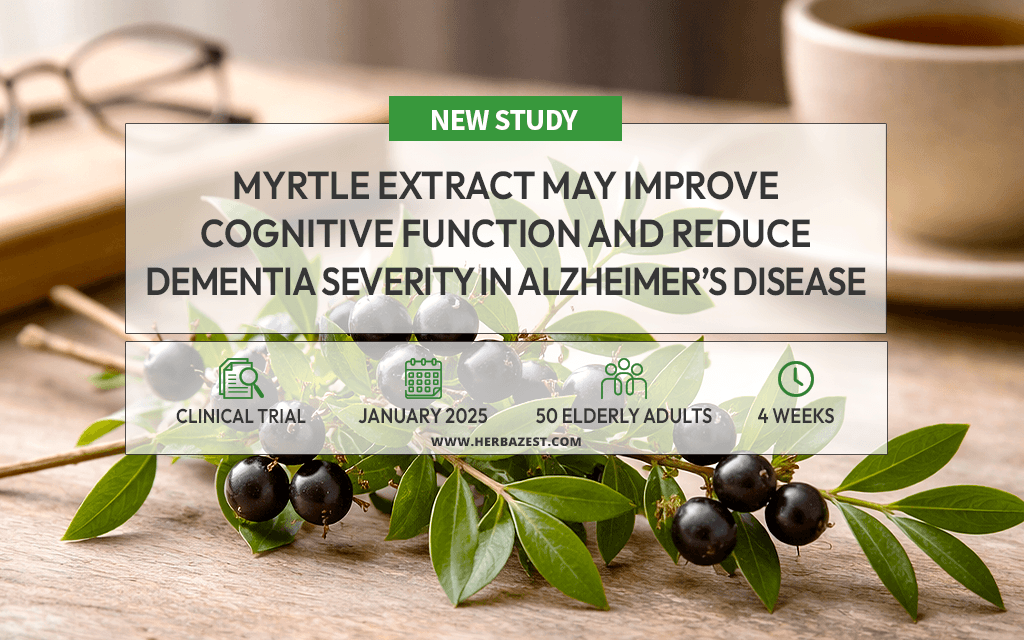
Alzheimer's disease is the most common cause of dementia and is marked by progressive memory loss and declining cognitive function.1 Although medications can help manage symptoms, they do not stop the underlying neurodegeneration. This has encouraged researchers to explore complementary approaches that may support brain health.
One plant of interest is Myrtus communis L., commonly known as myrtle. Traditionally used in Mediterranean and Middle Eastern herbal medicine, its leaves contain flavonoids and other antioxidant compounds that may influence processes involved in memory and learning.
The Study
Researchers conducted a randomized, placebo-controlled clinical trial to examine whether myrtle extract could improve cognitive function in people with mild to moderate Alzheimer's disease. The study included 50 elderly residents of a nursing home, all diagnosed with Alzheimer's disease according to established neurological criteria.
Participants were randomly assigned to two groups. One group received capsules containing myrtle extract, while the control group received identical placebo capsules. Cognitive function and dementia severity were evaluated at the beginning of the study and again after the intervention using two standard clinical tools: the Mini-Mental State Examination (MMSE) and the Clinical Dementia Rating (CDR) scale.
The Results
All participants completed the four-week trial. At the end of the study, the group receiving myrtle extract showed significantly better cognitive outcomes than the placebo group.
Participants taking the extract had higher MMSE scores, indicating improved cognitive performance, including memory, orientation, and attention. At the same time, their CDR scores were significantly lower, suggesting a reduction in dementia severity compared with the control group.
What Does this Mean?
These preliminary findings suggest that myrtle extract may support cognitive function and reduce dementia severity in people with mild to moderate Alzheimer's disease. Researchers believe these effects may be linked to the plant's antioxidant compounds and its potential influence on cholinergic activity, which plays an important role in memory and learning.
Although the study was relatively small and lasted only four weeks, the results highlight the growing interest in plant-derived compounds as complementary approaches to cognitive health. Other plants with compounds that show similar cognitive-supporting potential include sage, lemon balm, and ginkgo.
Sources
- BMC Complementary Medicine and Therapies, Preliminary clinical evaluation of capsules containing standard hydroalcoholic extract of Myrtus communis L. in patients with mild to moderate Alzheimer’s disease: a randomized, double-blind parallel-group clinical trial, 2026
Footnotes:
- Mayo Clinic. (2026). Alzheimer's Disease. Retrieved April 1, 2026, from https://www.mayoclinic.org/diseases-conditions/alzheimers-disease/symptoms-causes/syc-20350447