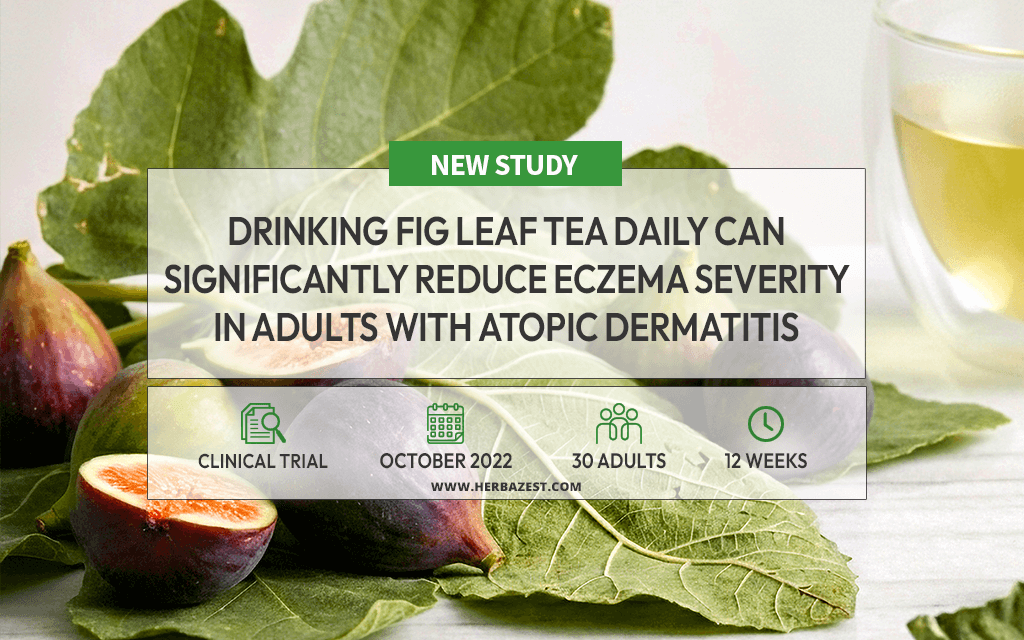
Atopic dermatitis, commonly called eczema, is a chronic skin condition marked by itching, redness, and recurring flare ups. While medications can help control symptoms, long term treatment can be challenging and may come with side effects. For this reason, researchers continue to explore gentler, food-based approaches that could support skin health over time. One such option is tea made from fig leaves, a traditional preparation that has shown promising effects in earlier laboratory and animal studies.1
The Study
Researchers from the Japanese Toyo Institute of Food Technology conducted a double-blind, randomized, placebo controlled clinical trial in 30 adults with mild atopic dermatitis. Participants were randomly assigned to drink either fig leaf tea or a placebo beverage daily. The study lasted 12 weeks, including 8 weeks of daily intake followed by 4 weeks of observation without the tea.
The main outcome was measured using the Eczema Area and Severity Index, or EASI, a dermatologist-assessed score commonly used in clinical trials. Researchers also evaluated safety through blood and urine tests.
The Results
After 4 and 8 weeks, participants who consumed fig leaf tea showed a significantly greater reduction in EASI scores compared to the placebo group. In fact, improvement was seen in 14 out of 15 participants drinking the tea. Symptoms tended to worsen again about 4 weeks after stopping intake, suggesting that continued consumption was important for maintaining benefits.
Blood tests confirmed that fig leaf tea was well tolerated, with no safety concerns identified during the study period. Some markers related to liver function even showed slight improvements, though these findings were considered secondary.
What Does this Mean?
This study suggests that regular consumption of fig leaf tea may help reduce mild atopic dermatitis when used consistently. While it is not a replacement for medical treatment, it may offer a supportive, low risk option for people looking to complement existing care routines.
The findings also reinforce growing interest in plant-based compounds that influence immune balance and skin barrier function. Other plants with similar properties being studied for skin health include chamomile, licorice root, nettle, and green tea.
Sources
- Nutrients, Efficacy and Safety of Fig (Ficus carica L.) Leaf Tea in Adults with Mild Atopic Dermatitis: A Double-Blind, Randomized, Placebo-Controlled Preliminary Trial, 2022
Footnotes:
- Bioscience, Biotechnology, and Biochemistry. (2020). Fig (Ficus carica L.) leaf tea suppresses allergy by acceleration disassembly of IgE-receptor complexes. Retrieved January 28, 2026, from https://pubmed.ncbi.nlm.nih.gov/31987005/