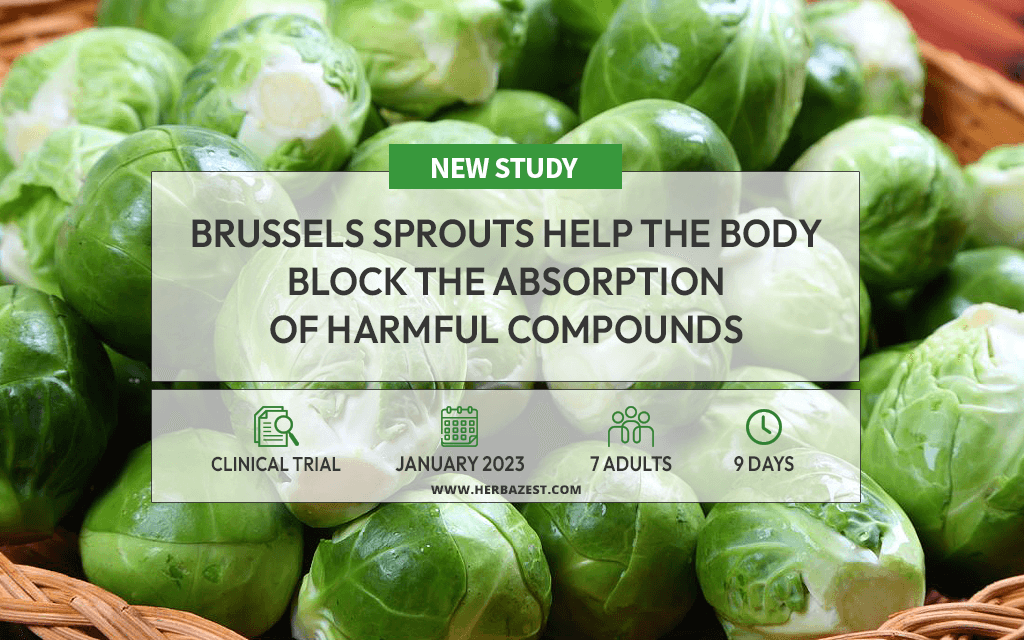
Brussels sprouts are well known for their nutritional value, yet researchers have also explored their broader effects on human health. Previous studies have shown that these cruciferous vegetables may help reduce DNA damage and support the body's ability to neutralize harmful compounds.¹,² A recent U.S. clinical trial expands on this evidence, showing that Brussels sprouts can influence how the body absorbs and processes certain foreign
The Study
The 2023 Brussels sprouts trial was conducted by researchers from Oregon State University and Lawrence Livermore National Laboratory in the United States. Their findings were published in the Toxicology and Applied Pharmacology journal.
The trial focused on benzo[a]pyrene (BaP), a powerful carcinogen found in charred meats, tobacco smoke, and polluted air. Seven healthy adults followed a diet that completely excluded cruciferous vegetables. They were then assigned for seven days to one of two regimens: eating 50 grams of cooked Brussels sprouts daily (about half a cup) or taking a 300 mg DIM supplement (DIM is a compound naturally produced in the body after eating cruciferous vegetables).
On the final day, participants received a safe, traceable micro-dose of BaP. Using an extremely sensitive technique called UPLC-accelerator mass spectrometry, researchers monitored BaP and its breakdown products in the blood over a 48-hour period to see how the body processed them.
The Results
The researchers found that both Brussels sprouts and DIM reduced the total amount of BaP detected in the blood by 56-67% compared to when no intervention was given. This suggests that both treatments slowed the rate at which BaP entered the bloodstream from the gut.
Peak concentrations of BaP in the blood were lower after the interventions, as were the peaks of several BaP metabolites. In one case, a metabolite's half-life and overall exposure were also reduced, indicating it was cleared from the body more quickly.
The findings point to a change in absorption, rather than metabolism, as the main reason for the reduced BaP levels. The effect was not identical for everyone, as some participants had especially strong reductions, while others showed smaller changes. This variability may be due to genetic differences in the enzymes that process carcinogens.
What Does this Mean?
This clinical trial suggests that Brussels sprouts support the body's ability to handle environmental toxins when included as part of a balanced and varied diet.
While the study found that even modest daily servings slowed the absorption of harmful compounds, the findings do not imply that Brussels sprouts alone can prevent health risks. Instead, they highlight the value of incorporating nutrient-dense, plant-based foods into everyday meals.
Other plant-based foods with similar protective properties include broccoli, watercress, and green tea.
Sources
- Toxicology and Applied Pharmacology., Benzo[a]pyrene toxicokinetics in humans following dietary supplementation with 3,3'-diindolylmethane (DIM) or Brussels sprouts, 2023
Footnotes:
Molecular Nutrition & Food Research. (2008). Consumption of Brussels sprouts protects peripheral human lymphocytes against 2-amino-1-methyl-6-phenylimidazo[4,5-b]pyridine (PhIP) and oxidative DNA-damage: results of a controlled human intervention trial. Retrieved August 15, 2025, from https://pubmed.ncbi.nlm.nih.gov/18293303/
Carcinogenesis. (1995). Reduction of oxidative DNA-damage in humans by brussels sprouts. Retrieved August 15, 2025, from https://pubmed.ncbi.nlm.nih.gov/7728983/